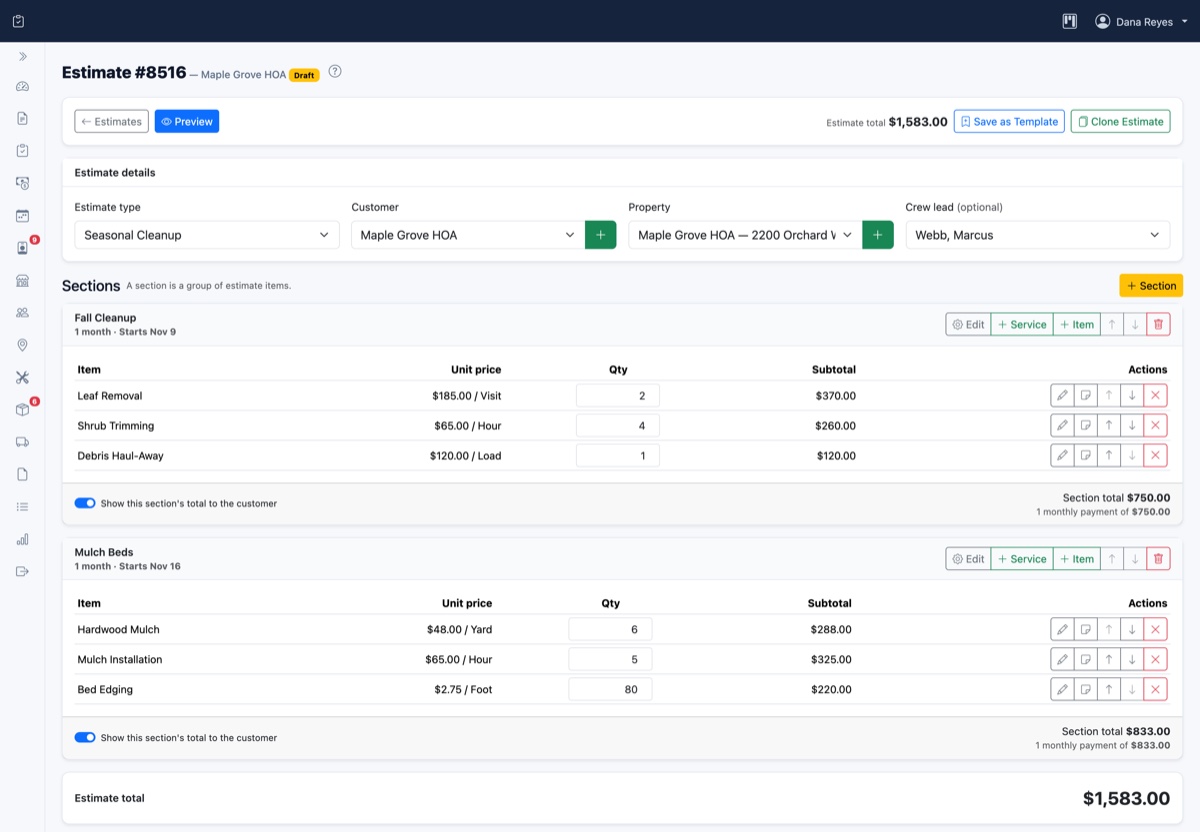
A field service estimate has two jobs. It has to make money if the customer says yes, and it has to make saying yes easy. Most estimating problems come from getting only one of those right. A low price with vague terms can win work you lose money on, while an accurate number buried in a confusing proposal can sit unanswered until the customer hires someone else.
This guide covers how to work out a price, what to put on the estimate and how to follow up. You can use the same method with a spreadsheet, a template or estimating software.
What should a field service estimate include?
A customer should be able to read your estimate without calling you to ask what it means. Include:
- Your business details: your company name, contact information and any license number your trade or state requires.
- The customer and the site: the customer's name and the service address, which may differ from the billing address.
- A date and an expiry date: when you wrote it and how long the price stands.
- The scope of work: each service or item, described plainly, with enough detail that the customer knows what they're getting.
- What's not included: the exclusions that would otherwise become arguments later.
- The price: line by line or as a package, plus any tax.
- Payment terms: any deposit, when the balance is due and how the customer can pay.
- Timing: the expected start date and how long the work should take.
- A way to accept: a signature line or an online approval, so "sounds good" becomes a clear yes.
Keep your common services and their descriptions in one service catalog. You'll write the wording once, and every estimate will describe the work the same way.
How to price a job
Start with your costs, then add the profit you want. Checking what competitors charge is useful, but their price says nothing about what the job will cost you.
- Estimate the labor hours. Multiply the crew size by the hours, and count travel, loading and cleanup. Base the hours on similar jobs you've actually finished.
- Use your full labor cost. A worker costs more than their hourly wage. Add payroll taxes, insurance and benefits. For a sense of scale, the Bureau of Labor Statistics reports that benefits made up 30 percent of private employers' compensation costs in June 2026. Your own figure may differ, so work it out from your payroll.
- Add materials and other direct costs. Include supplies, disposal fees, permits, subcontractors and rented equipment.
- Add your overhead. Rent, office wages, software, vehicles and phones have to be paid for somehow. Divide last year's overhead by your direct job costs to get a starting percentage, and review it at least once a year.
- Add your profit. Profit is what's left after the business has paid for itself, including paying you for your work.
A worked example
These numbers are made up, so swap in your own. Say two people will spend six hours each on a job, including travel, and materials cost $180.
- Labor: 12 hours at a full cost of $35 an hour comes to $420.
- Direct costs: $420 in labor plus $180 in materials comes to $600.
- Overhead: 20 percent of $600 adds $120, for a total cost of $720.
- Price: a 15 percent profit margin means dividing $720 by 0.85, which gives about $847.
Don't confuse markup with margin
Markup is a percentage of your cost, while margin is a percentage of your price. In the example above, adding a 15 percent markup to $720 gives a price of $828. That leaves $108 in profit, which is only about a 13 percent margin. The gap gets wider at higher percentages, so decide which number you're targeting and use it every time.
See the site before you commit to a price
Pricing from a phone call is fine for small, repeatable work. For anything else, the site visit is where you protect your margin. Look for what could slow the job down:
- Access for vehicles and equipment, including gates and parking
- The condition of whatever you're working on, and any earlier repairs
- Where materials and debris will have to go
- Pets, tenants, business hours or anything else that limits when you can work
Take photos while you're there. They help you price accurately, and they show the crew what to expect once the job is sold. When you can't see everything, such as damage behind a wall, say so on the estimate and explain how you'll handle what you find.
Terms that prevent arguments
A few plain sentences can save a long conversation at the end of the job.
- Exclusions. If hauling away the old unit costs extra, say that up front.
- Changes. Explain that added work gets priced and approved before it starts. A signed change order keeps this simple.
- Expiry. Pick a period that fits how quickly your material prices and calendar change, and print the date.
- Binding or not. Say whether the number is a fixed price or could change, and under what conditions. Rules on estimates vary, so check what applies in your state.
Know the cancellation rules for sales at home
If you sell to homeowners at their homes, the FTC's Cooling-Off Rule can give them three days to cancel certain sales. The rule has exceptions, including emergencies and some repair visits the customer requested. Before you start work on a job signed in someone's driveway, find out whether the rule applies. States can have their own rules too, so ask an attorney if your sales regularly happen on site.
Make it easy to say yes
How you present the price also matters. These habits can help without any change to the number:
- Send it quickly. Send the estimate while the visit is fresh in the customer's mind. Set a target for your team, such as the same or next business day.
- Offer options when they make sense. Two or three clear versions of a job let the customer choose between your options instead of choosing whether to hire you.
- Lead with the outcome. Describe what the customer ends up with, not just the tasks you'll perform.
- Remove steps. An estimate that can be approved from a phone is easier to accept than one that has to be printed, signed and scanned.
Follow up without being a pest
Silence usually doesn't mean no. The customer may be busy, waiting on another bid or unclear about something. Give each open estimate a next step and a date, then ask a specific question instead of "just checking in." For example, ask whether the start date still works or whether they'd like to see a smaller version of the job.
Track the outcome of every estimate, including the reason you lost it if the customer will tell you. Over time, your win rate by job type shows where your pricing or your pitch needs work. If you win nearly everything, your prices may be too low.
Common estimating mistakes
- Pricing from the wage instead of the full labor cost. The difference comes straight out of your profit.
- Leaving out travel and setup. You pay for those hours whether or not the estimate mentions them.
- Never comparing the estimate to the result. After each job, check actual hours and materials against your numbers. It's the fastest way to improve.
- Letting old prices linger. Review your catalog when supplier or labor costs change.
- Starting on a verbal yes. Without written approval, you have little to point to if the scope or price is questioned.
From signed estimate to scheduled work
A sale can still go wrong in the handoff to the field. Everything you promised has to reach the crew, so turn the signed estimate directly into a field service work order rather than retyping it. That carries over the scope, the exclusions and your site notes.
Spreadsheets and templates can handle this at low volume. Consider software once you're retyping details, losing track of open estimates or chasing signatures. See how CommandForce handles estimates, including online signing and conversion to work orders, or start free.
Frequently asked questions
What is the difference between an estimate and a quote?
People use the words loosely. An estimate is often treated as an informed approximation, and a quote as a fixed price. Because customers may not make that distinction, say on the document whether the price is fixed or could change, and under what conditions.
How long should a field service estimate be valid?
There is no standard period. Choose one that fits how quickly your material prices and schedule change, then print the expiry date on the estimate so the customer knows when the price may need to be updated.
Should I charge for estimates?
It depends on your trade and market. Many businesses offer free estimates for simple work and charge for complex site visits or detailed diagnostics, sometimes crediting the fee toward the job. Track how much time unpaid estimates take before you decide.