Good snow plow routes put your most urgent sites first, keep trucks close to their next stop and leave enough capacity to meet the promises in your contracts. Route planning matters more for snow than almost any other kind of work, because every customer needs you at the same moment, and often in the dark. Decide the order of your sites before the season starts, so nobody has to work it out at 3 a.m.
This guide covers how to work out your capacity, how to set up routes and what to do from the first forecast through to the final invoice.
Build snow plow routes around your promises
A summer route is designed to reduce drive time. A snow route has to do that while also meeting deadlines. Start with what your snow plowing contract promises each customer, then sort your sites into priority groups:
- Critical sites: medical facilities and other locations where access is essential.
- Early opening sites: stores, offices and schools that need to be clear before people arrive.
- Standard commercial sites: locations with more flexible timing.
- Residential: driveways, usually grouped by neighborhood and done once the larger sites are under control.
Within each group, keep the stops as close together as you can. Where you must choose, a customer's deadline should come before a shorter drive.
Work out your real capacity
Taking on more sites than you can reach is the most common way to break a promise in a storm. Do the math before you sign. These numbers are made up, so use your own.
- Add up plowing hours. Say your sites take a total of 18 truck-hours at your normal trigger depth, including travel.
- Check your window. If you promise completion within 6 hours, that's 3 trucks with no slack at all.
- Test a heavier storm. Deep snow takes longer. If an 8-inch storm takes 1.5 times as long, you'd need 27 truck-hours, or 4.5 trucks.
- Plan for trouble. Allow for a breakdown or a slow site, then decide whether you need another truck, a subcontractor or fewer customers.
Time your sites during the first storms of the season and update your numbers. A site that looks like a 45-minute job on a map may take well over an hour once you're working around parked cars.
Set up your routes before the first storm
- Visit every site before it snows. Mark curbs and obstacles, photograph existing damage and agree on where snow goes.
- Make a site sheet. Include the address, a site map, the contact, the trigger, any special instructions and the planned order of work.
- Assign a truck and a backup. Each route needs a lead driver, plus someone who could take over if that driver can't finish.
- Separate hand crews from plows. Sidewalk crews move at a different speed. Give them their own route and order, timed to the plow's arrival.
- Plan your salt. Decide where trucks will reload, and how much material each route will need in a typical storm.
- Do a dry run. Have new drivers run the route in daylight, particularly at sites with tight corners or hidden curbs.
Save each finished route as a work list, so that you can create all of its jobs at once when a storm comes.
Plan for storm day, step by step
When snow is in the forecast
Assign one person to watch the weather and make the call. The National Weather Service issues winter storm watches, warnings and advisories through local offices, and the criteria vary by location. A watch is issued when conditions are favorable for a significant event, while a warning is issued for a significant winter weather event and means travel may become difficult or impossible. Read your local forecast discussion as well, since timing and snow totals often change.
- Tell crews and subcontractors that they may be called, and when you'll confirm.
- Fuel trucks, load salt and check equipment.
- Have your site sheets, maps and contact lists ready.
When snow starts
- Choose a clear call-out method, and have crews confirm that they've received the message.
- Log the time snow starts and measure depth where your contract requires it.
- Send a route to each truck in priority order, then update it if the storm changes.
During the storm
- Plan your re-pushes. In a long storm, a site may need more than one visit. Decide when to go back to critical sites and when to move on.
- Have one dispatcher. Someone should know where each truck is and be able to shift work if a truck goes down.
- Log as you go. Crews should record arrival and departure times, snow depth, material used and any problems before they leave each site.
- Tell customers about delays. A short message is better than a customer calling to ask where you are.
After the storm
- Return for cleanup, windrows at entrances and any refreeze problems.
- Check for damage, and report anything you find to customers before they find it themselves.
- Service your trucks and restock your salt before the next storm.
- Bill per-push and per-event work while the records are fresh.
- Compare actual times with your plan, then fix the routes that ran late.
Staff for long storms
Snow work is hard on people. OSHA warns that long work hours may increase the risk of injuries and accidents and can contribute to worker fatigue. It suggests that employers allow frequent opportunities for rest breaks and nighttime sleep and look at staffing issues such as workload and understaffing. For a route plan, that means a few practical steps:
- Set a maximum shift, and name relief drivers before you need them.
- Rotate shoveling crews in and out of the cold. OSHA's cold stress guidance recommends frequent short breaks in warm, dry areas.
- Give people a way to say they're too tired to drive, without being penalized.
- Check whether commercial driver hours rules apply to your vehicles and operations.
Pay rules matter here as well. Time spent waiting for the snow to start may count as work time, depending on the circumstances. The Department of Labor's guide to hours worked explains on-call and waiting time, and your state may add its own rules. Our guide to crew management covers more on time records.
Keep trucks on the road
A truck down during a storm can put a whole route behind. OSHA's winter weather guidance says employers should have trained workers inspect vehicle systems such as brakes, tires, the cooling and electrical systems, oil and visibility, and should run an effective maintenance program. It also recommends an emergency kit in each vehicle, including items such as a flashlight, a shovel, a tow chain, traction aids, flares, jumper cables, water and blankets.
Beyond those basics, keep spare parts for your plows, such as hydraulic hoses and cutting edges, within easy reach. Know who you'd call for emergency repairs at night, and agree on rates with backup subcontractors before the season starts. If you use subcontractors, make sure their insurance and contract terms are sorted out ahead of time.
Common snow routing mistakes
- Selling more sites than you can reach. A full route on a 2-inch storm may be impossible in 10 inches.
- Planning only by geography. A tight route still fails if the clinic gets plowed last.
- Relying on one driver's memory. When that driver is sick or stuck, nobody else knows the route.
- Calling crews too late. Trucks that roll out after the storm builds will start behind and stay behind.
- Having no backup plan. Decide in advance who takes over a broken-down truck's sites.
- Skipping the logs. Without records, you can't bill accurately, and you may struggle to show what you did if a claim comes in.
Change the order when the storm changes
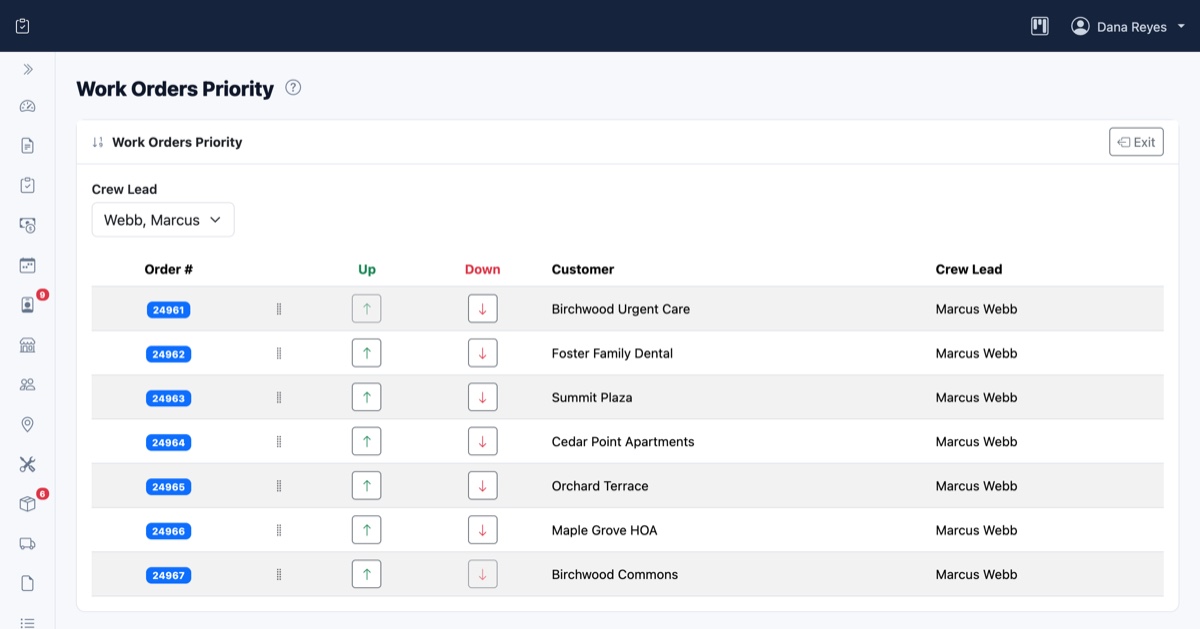
Even the best plan will change in a real storm. Crews need to see the current order on their phones, and dispatchers need to be able to move a site in seconds. In CommandForce, you can drag a crew lead's jobs into a new order, and the employee mobile dashboard shows them each job, with the address, notes and access details.
See how CommandForce work lists and routes work, or start free.
Frequently asked questions
How do I decide which sites to plow first?
Sort sites by the promises in your contracts. Critical sites such as medical facilities usually come first, then sites that must be clear before opening, then standard commercial sites and residential driveways. Keep stops close together within each group.
How many sites can one snow plow handle?
Add up the truck-hours for your sites and compare them with your promised window. In a made-up example, 18 truck-hours with a 6-hour window needs 3 trucks with no slack, and a heavier storm at 1.5 times the time needs 4.5.
How do I keep plow crews safe in long storms?
Set a maximum shift, name relief drivers in advance and build in rest breaks. OSHA warns that long work hours may increase the risk of injuries and accidents, and recommends frequent short breaks in warm, dry areas for cold work.