A good snow plowing contract says exactly when you'll show up, what you'll clear, how you'll get paid and who's responsible when something goes wrong. Most snow disputes come down to one of those questions, and they usually come up in the middle of a storm, when nobody has time to sort them out. A signed agreement settles them before the first flake falls.
This guide covers the terms most plowing contracts need, with sample wording you can adapt. It's general information rather than legal advice. Snow contracts can involve real liability, and the rules vary by state, so have an attorney review your final version.
What a snow plowing contract should include
At a minimum, cover these points:
- The parties and the property: who's hiring you, and the exact address or addresses.
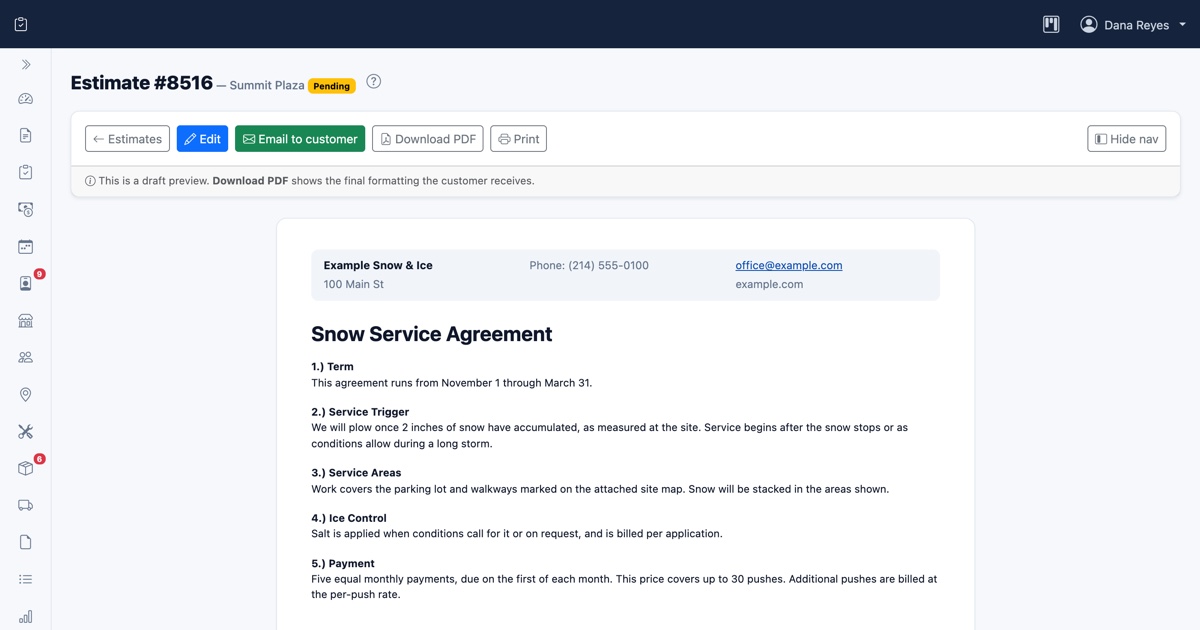
- The term: the start and end dates of the season.
- The trigger: how much snow it takes for you to come out, and how it's measured.
- The service level: what you'll do, and by when.
- The service area: what's covered, ideally on a site map.
- Ice control: when deicing happens, and how it's billed.
- Price and payment: your pricing model, due dates and late fees.
- Damage: how and when claims have to be reported.
- Liability and insurance: who's responsible for what, and the coverage you'll carry.
- Termination: how either side can end the contract.
Set a clear trigger
The trigger is the most important operating term in the contract, because it decides when you're obligated to go and when you can bill. Spell out:
- The depth: for example, 2 inches of accumulation. Lower triggers mean more visits and a higher price.
- How it's measured: a reading at the site, a named weather source or the nearest reporting station. Pick one, because snow depth can differ across a town.
- When service starts: during the storm, once it stops or when it reaches a certain depth.
- Long storms: whether you'll come back during a storm, and how many pushes it may take.
- Blowing and drifting snow: whether a call-out for drifting counts as a separate visit.
- Requests below the trigger: what you charge when a customer asks for service before the depth is reached.
Promise only what you can deliver
It's tempting to promise "clear by 6 a.m." on every site, but a storm that ends at 5 a.m. makes that impossible across a full route. Choose wording that matches your capacity. For example, you might promise to finish within a set number of hours after snowfall ends. Name the things that can delay you, such as continuous snowfall, travel bans, parked vehicles and equipment failure. A promise you keep will do more for your reputation than a better-sounding one you miss.
Avoid phrases like "keep the site free of snow and ice at all times" unless you truly intend to deliver that level of service and have priced it accordingly. An absolute promise can be hard to live up to, and it could be used against you in a dispute.
Define the site with a map
A marked-up aerial photo can prevent many arguments. Mark:
- The areas to plow, and those you won't touch
- Sidewalks, steps and entrances, and who clears each one
- Where to pile snow, including any spots that must stay clear, such as hydrants and drains
- Obstacles such as curbs, speed bumps and irrigation heads, which should get markers before the ground freezes
- Existing damage, with photos taken before the season starts
Say what happens when piles grow too large. Hauling snow off site is a separate job that needs its own price. Attach the map to the contract, and have both parties sign or initial it.
Be specific about ice control
Salting creates some of the most difficult questions in a snow contract, so don't leave them vague. Say whether deicing is automatic, based on a set condition, or only done on request. State which product you'll use and how it's billed, whether per application or as part of a seasonal price.
If a customer declines deicing, get that in writing. Say as well that deicers don't prevent all ice, and that ice can form again after you leave as snow melts and refreezes. Keep a record of each visit.
Spell out the money
The contract should match how you price the work. Our guide on how to price snow removal compares each model in detail.
- Per push or per event: list the rate by depth tier, and say what counts as one push or event.
- Seasonal: state the total, the installment dates and whether payments continue in a light winter. If you use a cap, say what's included and the rate beyond it.
- Extras: list your rates for hand shoveling, snow hauling and service below the trigger.
- Late payment: state any late fees and whether you can stop service, and check your state's rules on late charges.
Our guide to field service invoicing covers payment terms and follow-up in more detail.
Cover damage and customer duties
Plows sometimes hit things. Set a fair process in advance:
- Reporting: ask the customer to report damage within a set period, preferably in writing with photos.
- Exclusions: say how you'll handle items that weren't marked, and normal wear to turf at the edges of the plowed area.
- Customer duties: ask them to move vehicles and loose items, mark obstacles and tell you about hazards or changes to the site.
- Access: make it clear what happens if a blocked site can't be cleared.
Liability, insurance and hold-harmless clauses
Slip-and-fall claims are one of the biggest risks in this trade. This is the section where you most need a lawyer, for two reasons.
First, be careful about what you sign. Commercial customers often send their own contracts, which may ask you to indemnify them or hold them harmless, even for their own negligence. Read those terms closely and ask your attorney and insurance agent how they'd affect you.
Second, state law may decide whether such a clause counts at all. Colorado, for example, passed a Snow Removal Service Liability Limitation Act. According to its bill summary, it voids snow removal contract provisions that require one party to indemnify the other, hold it harmless or defend it in a lawsuit, where a provider is prohibited from mitigating a snow or ice risk. It also has exceptions, such as contracts with public bodies. Other states may have similar laws, so check where you work.
Ask your insurance agent what your policy covers, and whether it excludes any snow and ice work. Commercial customers may also ask for a certificate of insurance or to be named as an additional insured, so plan for that before you bid.
Keep records of every visit
A contract states what you promised, and your records show what you did. For each visit, log the date, time in and out, snow depth, work done, material used and crew. Dated photos also help. Keep these records for as long as your attorney and insurer recommend, because claims can arrive long after the snow has melted.
Sample contract wording
Adapt these examples to your business, then have an attorney review them. They're only starting points.
"Trigger: Contractor will plow when snow accumulation reaches [2] inches, as measured by [source]. Service will generally be completed within [number] hours after snowfall ends, subject to continuous snowfall, travel restrictions and site access."
"Ice control: Deicing will be applied [when conditions call for it, as determined by Contractor / only upon Customer's request] and billed at [rate] per application. Deicing does not guarantee an ice-free surface."
"Damage: Customer will report any claimed damage in writing within [number] days of the service visit."
Residential contracts
Homeowner agreements can be much shorter, usually a page or less, but should still cover the trigger, price, driveway limits and payment. If you sell at the customer's home, the FTC's Cooling-Off Rule can give them three days to cancel certain sales, with exceptions that include sales needed to meet an emergency. Your state may have its own rules, too, so check before you take deposits.
Common snow contract mistakes
- Working from a handshake. A verbal deal leaves you with little to point to after a claim.
- Signing the customer's form without reading it. A single indemnity clause can shift a lawsuit onto you.
- Promising a time you can't meet. Base your commitments on your actual route capacity.
- Leaving out the site map. "The parking lot" can mean something different to each party.
- Using an old template. Laws, insurance and your services change, so review your contract each year.
- Signing too late. Having every contract in hand before the first storm protects you when it counts.
Get contracts signed before the snow
Start your renewals well before the season, so you know your workload and can plan your routes. The Snow & Ice Management Association, a nonprofit trade association, also offers training and best practices, and its site links to a standard practice document on procuring and planning snow and ice services.
Sending agreements online makes it easier to get every customer's signature before the first storm. See how CommandForce handles online signing, including monthly payment plans and your own terms, or start free.
Frequently asked questions
What should a snow plowing contract include?
Cover the property, the season dates, the snow depth that triggers service, what you will do and by when, the service area, ice control, price and payment, damage reporting, liability and insurance, and how either side can end the contract.
What is a trigger in a snow contract?
The trigger is the amount of snow that obligates you to come out, such as 2 inches of accumulation. The contract should also say how the depth is measured and when service starts.
Should a snow contractor sign a hold-harmless clause?
Read it closely and ask your attorney and insurance agent first. These clauses can shift liability onto you, even for a customer's own negligence, and some states, such as Colorado, limit them by law.