To work out how to price snow removal, start with your hourly cost for the truck and operator, estimate the time each site takes, then add overhead and profit. From there, choose how to charge: per push, per inch, by the hour or with a seasonal contract. The right choice depends on your cash flow, your customers and how much weather risk you're willing to carry.
Snow pricing is harder than most service pricing because you don't know how much work a winter will bring. Prices also vary widely by region and snowfall. This guide gives you a formula, shows how each pricing model shifts the risk and walks through a seasonal contract with example numbers.
How to price snow removal: the basic formula
Use these steps for each site:
- Estimate the time. Measure the area you'll plow, then time similar sites or do a test run. Include the time spent moving and stacking snow, working around obstacles and driving to the next stop.
- Work out your full hourly cost. Include the operator's full labor cost, plus fuel, insurance, repairs and the cost of replacing your truck and plow. Remember that storm work often falls at night or on weekends, so overtime may apply.
- Add overhead. Cover your office costs, phones, software, marketing and the time you spend monitoring the weather. Off-season equipment costs belong here, too.
- Add profit. Divide your total cost by 1 minus your target margin. For a 15 percent margin, divide by 0.85.
A worked example
These numbers are made up, so replace them with your own. Say a small parking lot takes one hour to plow, including the drive, and your truck and operator cost $90 an hour.
- Direct cost: one hour at $90 comes to $90.
- Overhead: 20 percent of $90 adds $18, for a total cost of $108.
- Price: $108 divided by 0.85 comes to about $127 per push.
Then compare your number with local prices. Ask other companies for quotes where you can, and ask customers what they've paid before. If your number is far above the market, check your route and your equipment before you assume the price is wrong.
Choose a pricing model
Each model divides the risk of a heavy or light winter differently between you and your customer.
Per push
You charge a set price every time you plow a site. It's simple to explain and it pays you more in a snowy winter, but your income falls in a quiet one. Spell out the depth that triggers a visit and what happens in a long storm that needs several pushes.
Per inch or per event
You charge by the amount of snow in tiers, for example 2 to 4 inches, 4 to 8 inches and 8 to 12 inches. This matches the price more closely to the work, because deep snow takes longer. Agree on how snowfall will be measured, such as a named weather source or a reading from the site, or the invoice can turn into an argument.
Hourly
Hourly rates can suit unusual jobs, such as snow relocation or loader work, where the time is hard to predict. Many customers don't like open-ended bills, and the rate gives you no reward for working efficiently. Set a minimum charge, so short visits still cover your costs.
Seasonal contract
The customer pays a fixed amount for the winter, usually in monthly installments. You get predictable income and they get a predictable bill. The catch is that you're taking on the weather risk: a heavy winter could cost you far more than you planned.
Seasonal contract with a cap
A cap covers a set number of pushes or inches, and anything beyond that is billed at an agreed rate. You still have steady income, while the customer's price stays fixed for a normal winter. For many companies, it's a good compromise.
Build a seasonal price step by step
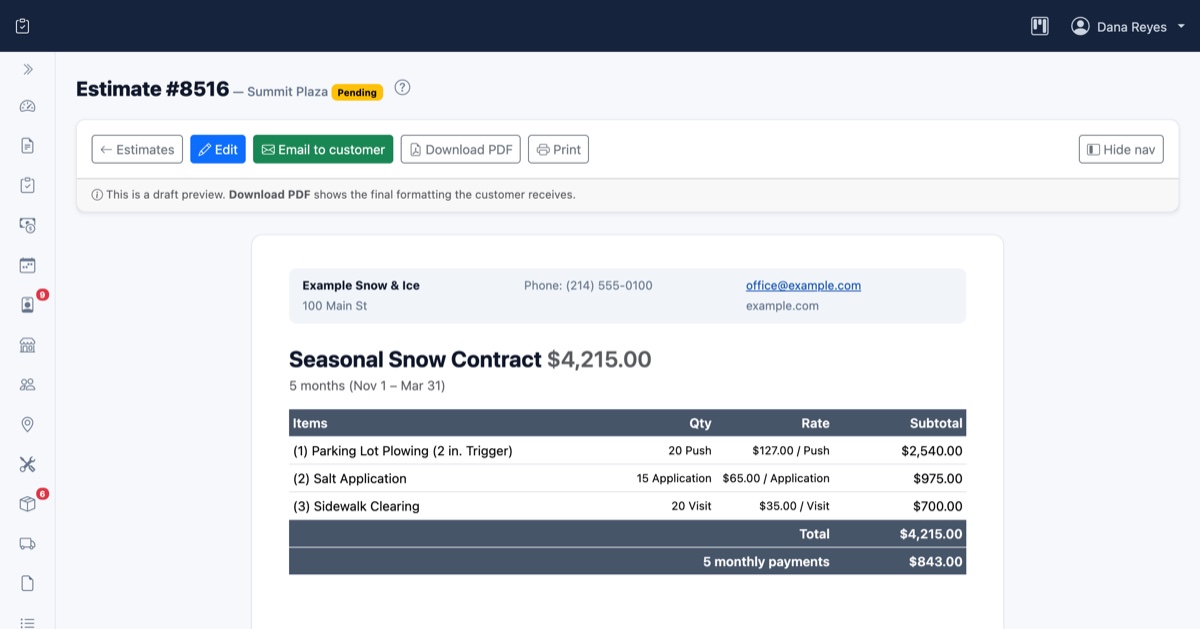
Start with your local snowfall records, not last year alone. Use several years of data to estimate a typical number of events, then build your price from it. Continuing the made-up example above, here's a price for a five-month contract:
- Plowing: 20 expected pushes at $127 comes to $2,540.
- Salt: 15 applications at $65 comes to $975.
- Sidewalks: 20 visits at $35 comes to $700.
- Total: $4,215 for the season, or $843 a month for five months.
Now test it against the weather. If a heavy winter brings 30 pushes, you'd do another $1,270 of plowing at the same rate. If a light winter brings just 10, you'd keep that same amount. Add a cap to limit the downside. In this example, you might cover up to 30 pushes, then charge $127 for each one after that.
What should change the price
Two lots of the same size can take very different amounts of work. Adjust for:
- Obstacles: curbs, islands, light poles, parked cars and loading docks.
- Snow storage: if there's nowhere to pile it, you may have to move it, and that can be a separate job.
- Trigger depth: a lower trigger means more visits. A 1-inch trigger costs more over a season than a 3-inch one.
- Service level: a promise to be clear by 6 a.m. or to keep a site clear throughout the storm needs more equipment on standby.
- Hand work: sidewalks, steps and entrances take far more labor per square foot than an open lot.
- Location: a site far from the rest of your route costs you travel time during the busiest hours of the storm.
- Risk: hospitals, retail sites and busy walkways can carry greater slip-and-fall exposure, which may affect your insurance costs.
Price driveways and small jobs simply
Residential work is usually sold per visit or by the season. Price it with the same formula, using your drive time and a minimum charge. Group driveways on the same streets where you can, because a single driveway across town can cost more to reach than it earns during a storm. Our guide to lawn care routes explains the same density idea for summer work.
Price ice control separately
Salt and other deicers are often where the profit and the risk both sit. Price each application by area or by the job, rather than including it in plowing. Include your material, your spreader and the trip, and make clear whether salting is automatic or only happens on request.
Keep records of each application, including the date and time. They help you bill accurately, and they can be useful if someone questions the service later. Training is available as well. The Snow & Ice Management Association, a nonprofit trade association, offers training and best practices, including a deicer applicator certification.
Include what snow work really costs you
Some costs don't appear on a single job, but every price has to cover them:
- Standby time: crews and subcontractors may need to be ready even if the storm misses you.
- Insurance: snow coverage can be costly, so get a quote before you set your prices. Ask your agent specifically about snow and ice work.
- Breakdowns: a broken plow during a storm may mean a costly emergency repair or a subcontractor.
- Pre-season work: site visits, maps and marking stakes take time before you've earned a dollar.
- Off-season payments: truck and equipment bills continue in months with no snow.
Budget for crew safety
Long shifts in the cold have a real cost. The National Weather Service notes that at a wind chill of -19°F, exposed skin can freeze in 30 minutes. OSHA advises employers to schedule frequent short breaks in warm, dry areas and to have people work in pairs. It also warns that shoveling can bring exhaustion, back injuries or heart attacks. Build breaks and rotations into your time estimates, because a tired crew is slower and more likely to get hurt.
Put your price in a clear contract
Your price is only as good as the terms around it. Whichever model you choose, say in writing:
- The start and end dates of the season
- The depth that triggers service, and how it's measured
- When the site will be cleared, and what can delay it
- Which areas are covered, ideally marked on a site map
- How salting is requested, performed and billed
- What happens to payment in a very light or very heavy winter
- How snow gets stacked or removed, and who's responsible for damage
Have an attorney review your contract, especially the language on liability and slip-and-fall claims. Our guide to the field service estimate covers more on writing clear proposals.
Collect the money you've earned
Get seasonal contracts signed and any deposits in hand before the first snow. Bill per-push work quickly, while the customer can still remember the storm, and keep your dated records with each invoice. Our guide to field service invoicing covers payment terms and reminders, and online payments can make monthly billing easier.
Common snow pricing mistakes
- Pricing from one winter. A single mild or severe season says little about what's typical.
- Selling unlimited service too cheaply. An uncapped contract can turn a big winter into a big loss.
- Forgetting the off-season. Winter revenue has to carry equipment costs for the whole year.
- Taking too many sites. If you can't reach everyone within your promised time, one storm can cost you customers.
- Leaving out the trigger. Without one, customers and crews can disagree about when service was due.
- Treating salt as a free extra. Material and labor costs add up over a season.
Keep every storm on the books
Per-push and per-event pricing only work if every visit gets recorded and billed. When a storm hits at 2 a.m., paper tickets are easy to lose. Look for a system that saves your site lists as routes, records the work from a crew's phone and turns it into an invoice. See how CommandForce handles estimates, including monthly payment plans, or start free.
Frequently asked questions
Should I charge per push or a seasonal rate for snow plowing?
It depends on how much weather risk you want to carry. Per-push pricing pays more in a snowy winter but less in a quiet one. Seasonal contracts give steady income, but a heavy winter can cost you more than you planned. A seasonal contract with a cap is a common compromise.
How do I calculate a seasonal snow removal price?
Use several years of local snowfall records to estimate typical events, then multiply by your price per push. Add salt and sidewalk work. In our made-up example, 20 pushes at $127, 15 salt applications at $65 and 20 sidewalk visits at $35 come to $4,215 for the season.
Should salt be included in the price of plowing?
Pricing it separately is usually clearer. Charge for each application by area or by the job, include material, equipment and the trip, and say in writing whether salting is automatic or only on request.